/ resources
May 7, 2026

Rising prices are reshaping how consumers shop online, but ecommerce conversion optimization in 2026 is not solely about offering the lowest price. The retailers best positioned to win may not be the ones with the lowest prices, but the ones with the fewest friction points.
A new Bizrate Insights survey of more than 1,000 U.S. consumers reveals that expectations around free shipping, transparent pricing, and return policies have become make-or-break moments. Miss them, and shoppers don’t just abandon their cart. More than half deflect straight to a competitor.
Underlying all of this is a pervasive economic anxiety. Nearly 69% of shoppers say they are very or extremely worried about inflation and rising prices, and that concern is showing up directly in purchasing behavior. Six in ten shoppers say they are more focused on price today than they were a year ago.
Yet the data also reveals something unexpected. Consumers aren’t pulling back. Nearly two-thirds (63%) shop online at least weekly, and 35% have actually increased their frequency over just the last three months. This is a market that is active, engaged, and highly attuned to value.
The retailers who understand that distinction will be positioned to win.

Beneath all of this behavior is a pervasive economic anxiety. Sixty-nine percent (69%) of shoppers are very or extremely worried about inflation and rising prices and that concern isn’t distributed evenly. Women (73%) are more worried than men (65%), and lower-income households under $50K (73%) and households with kids (78%) are especially stressed.


This anxiety is showing up directly in purchasing behavior. Six in ten shoppers say they are more focused on price today than they were a year ago.
When asked what matters most in choosing where to shop, free shipping (57%) beat out lowest price (45%) by a significant margin. Brand trust came in third at 27%, followed by discounts and promotions at 26%.

Free shipping isn’t just a perk anymore. It’s the baseline expectation that determines where shoppers will even consider buying. The effect is especially pronounced among older shoppers, with 79% of those aged 65+ prioritizing free shipping, as do 58% of low-income earners.
Even among high-income earners ($200K+), 45% still put free shipping first. The message is consistent across every segment: the perception of getting a deal on shipping consistently outweighs a lower item price.
Shoppers have a clear mental model for what earns free shipping: 56% expect it once they’ve spent between $25 and $49. Another 8% expect shipping to always be free regardless of order size.

Retailers who set their free shipping threshold above $50 are likely triggering abandonment and those who set it well above that are almost certainly losing customers who feel their expectation isn’t being met.
Aligning thresholds to the $25–$49 range isn’t just generous; it’s a direct ecommerce conversion optimization.
If free shipping is the biggest attractor, surprise fees are the biggest repellent. Forty-two percent of shoppers say they frequently or very often abandon a cart due to unexpected costs; things like taxes, handling fees, or charges that only appear at the final step of checkout.

Younger shoppers are the most reactive: 60% of those aged 18–34 abandon often when surprised by extra costs. Parents (55%) are more likely to abandon than non-parents (38%).
Only 12% of shoppers say they rarely or never abandon due to extra costs, meaning almost everyone is at risk of losing a sale this way.
Of all the friction points in the checkout experience, paid returns may be the most underestimated. A $10 return fee on a $50 purchase is enough to drive 72% of shoppers to abandon the transaction.

Women (73%) and shoppers aged 35–44 (77%) are the most sensitive.
But what happens next is equally revealing: of those who abandon, 52% defect directly to a competitor offering free returns, and another 28% go searching for a cheaper alternative elsewhere. Only 7% abandon the purchase entirely.

The takeaway is sharp: paid return policies don’t just lose sales. They actively hand customers to competitors.
One of the most actionable findings in this study is just how modest a discount needs to be to convert a hesitant shopper. Forty-three percent of shoppers say a 10 to 20% discount is the minimum needed to tip them from “on the fence” to “purchase complete.”

Only 17% require a discount of 30% or more. Men are even easier to convert with smaller offers: 54% respond to 10–20% off, compared to 44% of women. Older shoppers are the most easily converted segment, with 63% moved by discounts in that modest range.
The implication for promotional strategy is significant: many retailers are likely over-investing in deep discounts, burning margin to convert shoppers who would have responded to a much lighter offer.
Discounts don’t just work when offered, shoppers are actively seeking them out. Seventy-eight percent of shoppers describe themselves as active promo code hunters, seeking out codes all or most of the time before completing a purchase.

Thirty-one percent say they always look for a code and won’t check out without one. Only 2% say they rarely or never look.
This behavior is even more pronounced among women and households with kids (85%).
The implication is clear: if a customer can’t find a promo code on your site, they will leave to look for one on coupon aggregators, competitor sites, or Google, and they may not come back.
Proactively surfacing or auto-applying promo codes isn’t just a nice conversion nudge; it’s a retention mechanism that keeps shoppers in your funnel rather than sending them off-site.
Not all shoppers are created equal, and one segment stands out above the rest: households with children.

Parents are high-frequency, high-engagement, and highly promo-responsive; a powerful combination for any retailer.
Consider the following:

They also buy across a wider range of categories, over-indexing on clothing, groceries, beauty, health, toys, pet supplies, books, home improvement, and home goods. The only category where they don’t over-index is electronics.
For retailers with broad assortments, parents are the audience most worth investing in — both through targeted promotions and through the experience features (free shipping, transparent returns) that drive their loyalty.
The clearest takeaway from this research is that conversion in 2026 isn’t won on price alone — it’s won on clarity, value, and ease.
42% abandon due to unexpected fees, 72% will walk over a $10 return fee → Show total cost (shipping, taxes, returns) early
10–20% converts 43% of shoppers → Avoid margin-killing promos, target instead
57% prioritize free shipping over price → Set thresholds at $25–$49 to match expectations
78% look for codes before checkout → Auto-apply or surface codes to prevent drop-off
Shoppers aren’t asking retailers to be the cheapest option in the market. They’re asking for transparency about total cost, for free shipping at reasonable thresholds, for return policies that don’t feel punitive, and for discounts that feel attainable.
Meet those expectations and you earn the sale, and very likely the repeat visit. Miss them, and 72% will walk, half of them straight to a competitor. The brands that will win this environment are those that treat pricing friction as a ecommerce conversion optimization problem, not just a cost management decision.
This study was conducted by Bizrate Insights via an online survey among a sample of 1,010 U.S. adults. Fieldwork was conducted from March 20 to March 29, 2026.
Respondents were recruited through Bizrate’s panel, along with partner panels, and were screened to meet key eligibility criteria, including age and shopping frequency.
The sample was designed to be representative of U.S. adults age 18+.
The margin of error for a sample of this size is approximately ±3.1 percentage points at the 95% confidence level.
Percentages may not sum to 100% due to rounding. Differences between subgroups are tested for statistical significance at the 95% confidence level.

Amazon’s Prime Day 2026 sale gives us a clear look at how online shoppers respond when urgency, discounts, and...

Qualtrics is one of the best customer experience and market research platforms on the market, but not every ecommerce...
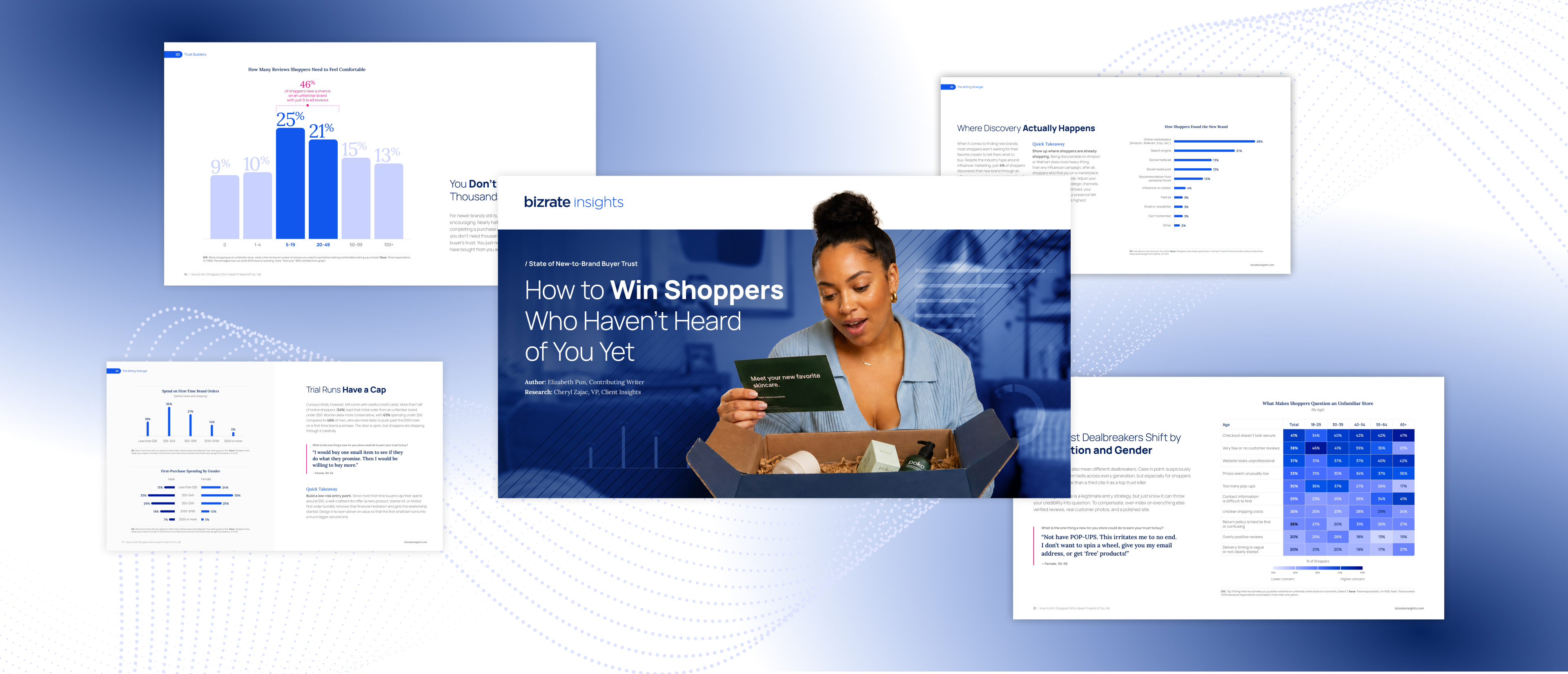
First-time buyers are out there, and they’re willing to spend with you if you can put them at ease. Our latest research shows what helps shoppers feel ready to take a chance on a new brand.


