/ resources
May 13, 2026


Contributing Writer, Bizrate Insights
Updated 5/13/2026
For a PDF downloadable version of this report: Download Now
As these tools reshape the shopping journey, they’re also changing how shoppers decide what (and whom) to trust. For brands and retailers, understanding how trust in AI impacts credibility and confidence is becoming just as important as the technology itself.
In this report, we explore consumer trust in the age of AI. We examine how shoppers are responding to AI-driven experiences today, what earns their confidence when it’s time to check out, and how brands and retailers can align with these expectations and build trust in a rapidly evolving landscape.
Bizrate Insights surveyed a nationally representative sample of 1,006 U.S. online shoppers aged 18+ in November 2025 to explore consumer trust around AI.


Shopper trust hasn’t quite caught up to the rapid rise of AI in ecommerce, but that’s not to say demand won’t grow. When asked how much they trust AI while shopping, 38% of consumers say they somewhat or completely trust it, while another 30% openly distrust it. About a third (32%) sits squarely in the middle with no strong opinion either way…yet.
Age plays a major role in those trust levels. Younger shoppers (18 to 29) are the most open to AI, with 34% somewhat trusting and 14% completely trusting it, the highest of any age group. Adults aged 55 and over show the opposite trend: 24% completely distrust AI, and fewer than 1% say they completely trust it.
Meanwhile, shoppers aged 30 to 54 show the highest neutrality, with 25% to 35% falling into the undecided middle.

How often someone shops online is one of the strongest predictors of their trust in AI. High-frequency shoppers are the most open to using AI tools and recommendations, with 39% somewhat trusting AI and 18% completely trusting it. Low-frequency shoppers, on the other hand, are much more wary; 26% completely distrust AI, the highest distrust level of any group.

Despite the noise around AI, shoppers still start their journey in the usual places. Retailer sites dominate the starting line, with a massive 79% of consumers kicking off their product search on sites like Amazon and Walmart. That number climbs even higher among older adults (88% to 91% of those aged over 55) and high-income earners (85% of $150K+ households).
Search engines come next at 59%, keeping Google in the game. Meanwhile, social media shines among younger shoppers, with 39% of 18 to 29-year-olds starting on TikTok, Instagram, and the like.

Then there’s AI. Only 12% of shoppers start with AI chat tools. Usage rises to 20% for 18 to 29-year-olds, 21% of highfrequency shoppers, and 28% of people who already trust AI.
Overall, shoppers are curious about AI, but when it’s time to actually look for something, most still stick to what’s familiar and proven. The future may be AI-driven, but the present still belongs to retailer sites and search engines.
Start where shoppers do. Discovery still happens on retailer sites and search engines, not AI chat tools. Focus on using AI to enhance existing journeys, rather than replace them.
From a variety of tools and resources available, shoppers quickly turn to other shoppers to find out what’s worth buying online. Customer reviews are the #1 trusted information source for purchases (71%), followed by friends and family (54%) and customer photos or videos (41%). Expert reviews have a solid following (34%), especially among higher-income shoppers (47% of those earning over $150K).
Meanwhile, AI-generated summaries rank low at 15%. That number does double to 31% among shoppers who already trust AI, showing a clear split between AI skeptics and adopters.
Influencer reviews sit at the bottom overall (12%), but they resonate more with women (24%) and younger adults (24% of ages 18 to 29).
In the AI era, shoppers lean toward familiar, human-centered sources. Trust still starts with other people.

Customer reviews are baked into the way people shop online. Nearly everyone (95%) reads reviews before buying, and 3 in 4 shoppers (72%) read them always or often, turning to real experiences from other people to guide all their buying decisions. Only a tiny 5% rarely or never check reviews, and that’s mostly among less frequent online shoppers who likely aren’t as comfortable with online buying yet.
Younger shoppers, in particular, are obsessed with reviews, with 82% of 18 to 29-year-olds reading reviews always or often. They’re constantly comparing, researching, and making sure they get the best deals while minimizing risk.

Despite relying heavily on reviews, most shoppers (88%) at least sometimes question whether what they read is real. Nearly half (44%) say they always or often doubt reviews. This skepticism shows up across every demographic, so almost everyone is reading reviews with a bit of suspicion.
Younger shoppers are the most wary. Among 18 to 29-year-olds, 53% always or often question authenticity, likely because they’ve grown up spotting fake content online. Older shoppers are slightly less suspicious; 41% of those aged 55 to 64 and 32% of those aged over 65 report always or often doubting reviews, leaning more toward “sometimes” or “rarely.”


Confidence is mixed when it comes to telling which reviews are written by a human and which are spun up by AI. About half of shoppers (51%) say they’re at least somewhat confident they can spot a fake review, which also means half are unsure or not confident at all.
Younger shoppers feel the most equipped, with 73% of 18 to 29-year-olds thinking they can spot AI-generated content, likely a side effect of growing up online. Confidence drops with age, as just 31% of people aged 55 to 64 feel at least somewhat confident.
Some shoppers trust their own instincts, others don’t. Yet everyone is navigating the same blurry line between human and AI.


Put the “human” front and center. As shoppers try to decode what’s AI-generated, brands and retailers that highlight the human side of their review ecosystem (actual customers, actual experiences) make it easier for people to believe what they’re reading.
What makes reviews feel real? Over half say a mix of positive and negative reviews feels honest (54%), while half of shoppers want user photos or videos to prove there’s an actual human behind the feedback. Natural, human-sounding language makes them more believable too (39%), as well as “verified purchase” tags (35%) and brand engagement (24%).

Make it obvious it’s real. Shoppers are hunting for reliable signals of authenticity, so double down on markers like verified buyer badges to show your reviews come from actual humans, not bots.
Most consumers don’t use AI while shopping yet. Only 16% say they use AI regularly while shopping, while half (52%) say they rarely or never use AI at all.
The same pattern shows up with AI-powered checkout. Three out of four shoppers have never completed a purchase directly within an AI-powered experience, like ChatGPT or Alexa. However, the interesting middle shows up yet again: 32% say they haven’t tried it yet, but they’d be open to giving it a shot.


Adoption is low, but the runway is long. Keep your traditional channels strong, as most shoppers currently stick to familiar paths. That said, with a third of shoppers open to using AI to buy, now’s the time to test and experiment with AI features that feel genuinely helpful, so you can evolve as shoppers do.
Consumers are currently most comfortable using AI help for price comparison (55%) and package tracking (47%). These are straightforward, factual tasks that don’t require taste or judgment.
However, shoppers pull back as the tasks get more personal, layered, or risky. Comfort drops to 33% for “finding the right product,” 23% for returns and support, and even lower for automated reordering (19%) or style/fit recs (17%).
When the job is simple and the stakes are low, shoppers welcome the help of AI. When a task requires greater trust, nuance, or money on the line, most shoppers would rather stay in control.

Blend AI efficiency with human judgment. Let AI handle the repetitive jobs, but pair it with human-reviewed recommendations for anything taste-based or high stakes.
When an AI feature recommends a product, the top signals that make it feel trustworthy include price comparisons (48%) first and foremost. Verified customer reviews take second place (40%), reinforcing human-focused reviews as a top trust signal in the AI era.
Following that are explanations of why the AI tool made the recommendation (36%), and recommendations from trusted brands (27%).

As AI reshapes ecommerce, some embrace it for convenience, others resist, and a sizable third remains undecided…though demand could grow quickly.
Success comes from knowing your audience. Strengthen the existing channels they trust today, while experimenting with the AI-driven experiences they’ll expect tomorrow, tailoring your approach and trust signals to the mix of shoppers you serve.
Know your audience before designing your AI strategy. Different segments show different comfort levels, so testing is key to understand what specific features your consumers respond to.
AI is currently supplemental. Younger and frequent online shoppers use AI more, but it’s still not the default starting point. Maintain strong traditional channels while focusing on low-risk, operational AI wins that enhance existing journeys (e.g., site search, navigation, merchandising).
Human trust wins. Reviews are the #1 decision-driver, but shoppers question authenticity. Use verified buyer badges and real human cues to build confidence.
For a PDF downloadable version of this report: Download Now

Amazon’s Prime Day 2026 sale gives us a clear look at how online shoppers respond when urgency, discounts, and...

Qualtrics is one of the best customer experience and market research platforms on the market, but not every ecommerce...
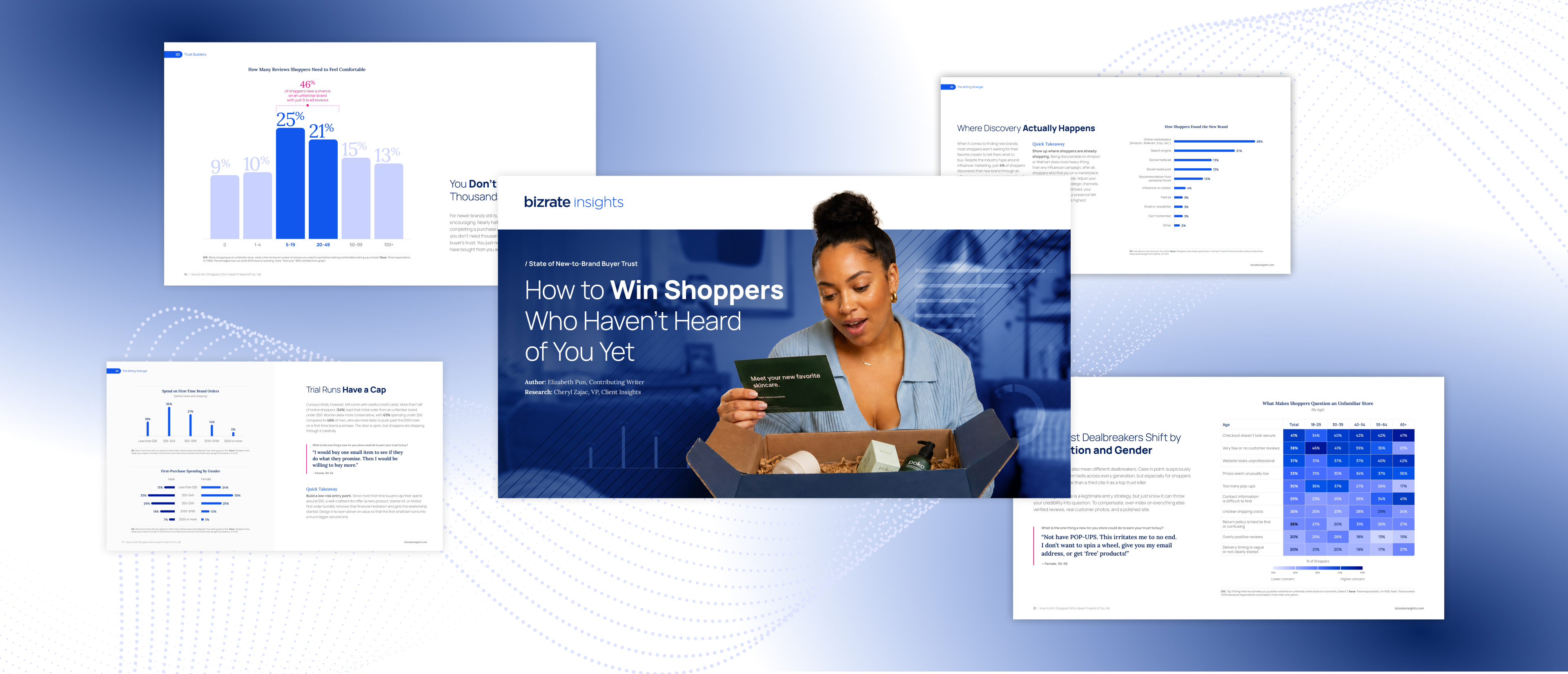
First-time buyers are out there, and they’re willing to spend with you if you can put them at ease. Our latest research shows what helps shoppers feel ready to take a chance on a new brand.


