/ resources
November 17, 2025


Content Manager, Bizrate Insights
Updated 11/25: The following blog is adapted from Bizrate Insights’ past library of white papers and guides that we’ve made publicly available. Enjoy!
If you lead or manage an ecommerce business, technology can have a crucial impact on your customers’ experiences and your team’s day-to-day tasks.
Chatbots offer a wide range of benefits that are ideal for ecommerce operations, from helping customers find products and answering their questions, to increasing conversions and reducing costs.
In this guide, we’ll cover all the ways chatbots can be used to improve your ecommerce business through the various benefits they provide. With the right strategies in place, ecommerce managers can capitalize on the advantages chatbots provide to build successful relationships with your customers.

We humans are social animals. We value interaction. We value conversation. A lot of decisions we make feel less stressful after a conversation. A call with a knowledgeable salesperson, an interaction with a caring retail clerk goes a lot further than reading the instructions on a box, or reading the specs of a product on a website. There’s something about being able to discuss our needs, engage in a dialog, that reassures us, makes us feel more at ease, and leads to a more enjoyable shopping experience.
On a website, this conversational marketing component can be accomplished in a number of ways. Offering an 800 phone line is the most high-touch, personable way to provide this experience. However, phone conversations are not very scalable – and people hate to be placed on hold. This is where having a chat widget on your ecommerce website can create that personable one-on-one experience without the need for voice calls.
Chat widgets are great in pre-sale scenarios, to defuse a customer’s fears, to assure the customer about return policies, to guide them to the right products and more. Chat widgets are also very helpful in customer support, resolving fulfillment issues, handling refunds and returns, and even mitigating buyer remorse by highlighting features and benefits the customer might have missed.
Research conducted by Salesforce shows us that 88% of ecommerce consumers believe the experience a company provides is as important as its product or services. The experience a company provides is as important as its product or services. Customers like to feel accompanied. We don’t like shopping alone. And therein resides the great power of conversational marketing.
A representative can only handle one phone call at a time. An adept chat representative can juggle a few chat conversations simultaneously. But beyond that, both solutions run into a major problem of scalability. A company can hire more and more phone and chat operators, but this can take a significant bite out of the bottom line. That’s where we find the value of chatbots.
Humans bring the most value as pathfinders, as trailblazers, as creative problem solvers. However, when you scale any transactional interaction, predictable patterns emerge. Inquiries can be separated into categories. Questions can be codified into frequently asked questions and their answers, slightly less common use cases with predictable patterns, and eventually the one-off cases where a problem solver is needed. By leaving the third scenario to human representatives and assigning the first, much more frequent scenario to robots, an ecommerce website can scale conversation to an almost infinite level.
The main reasons ecommerce sites install a chatbot are:
They handle routine, patterned conversations: Every business has routine questions that get asked of their front line staff. These are easy to manage, but time consuming. Chatbots help customers do easy tasks in a self-service manner, saving them the time of being on the phone with your customer service agents. It also ensures that your client services department can focus on more complex problems that require human intervention without getting too deeply in the weeds on simple queries.
To accelerate and scale lead generation: You can use chatbots to track customer interest in your products by evaluating interactions for certain keywords and behaviors. Once a lead has crossed a certain behavior threshold, you can then evaluate them for your sales team to follow up on.
To enhance your nurture campaigns: Forms are so 2010s. Chatbots provide interactivity which can help people get over their dislike of filling in forms. They can also ask questions which, if answered, will qualify your prospect into different stages of your nurture cycle.
When attempting to introduce chatbots into your company, you should first determine what exactly your organization’s goals are. Ask yourself questions such as:
Once those all important questions are answered, you’ll be well on your way to understanding where and how chatbots can be utilized in your organization, as well as having a much clearer internal picture of the kinds of issues you can solve.
After making your determination, it’s also helpful to think about the kinds of data you want your bots to collect for you, and how you’re going to manage it. To misquote an old adage, unused data is the same as not having any data at all.
Processes and teams must be in place to manage the data your chatbots collect and the conversations they have with your clients and prospects, otherwise your investment may not end up aligning with your goals.
Chatbots are not tools that you can just set and forget. They require human oversight and consistent interaction in order to drive real value for your organization. Ultimately, this should require less work than manually performing chatbot automated tasks yourself, but to reach this level, systems do need to be put in place. This requires a couple of considerations:
Chatbot Management:
To successfully manage your chatbots, conversations need to occur internally that determine how you’re going to handle incoming messages, and how your bot will interact with your clients or prospects. There is a level of finesse to getting chatbots to work well in the first place — ultimately they will only parrot the words that an administrator programs into them.In order for chatbots to be effective, the administrator needs to know your workflows, common customer concerns and different routing scenarios for user recommendations.This can make all the difference between a good implementation and a subpar one, and it requires detailed input from the teams who will be utilizing the bot.
Team Management:
The implementation of automation can be a scary thing for anyone in any profession, especially when it may take away some of their core job functions. Add that to the traditional hesitance that many offices have toward change, especially in terms of digital transformation, and a team management strategy is required. You have to sell chatbots internally as a net benefit for individual employees. One way to do this is to talk about bots as what they are: an assistant to help with everyday problems and reduce work that would otherwise be time-consuming and not business-forward. It should be made very clear that these bots are, in fact, assistants, not replacements.

When you’re looking to implement a chatbot, launching it as a pilot program for a limited set of users and a limited population of clients and prospects is the best way to ensure that you are driving value and ROI for your company. As with any short-term project, it is integral to success that you set goals and understand how to calculate your return on investment. This equation could vary greatly depending on what you’re using the chatbot for. Some examples would be:
For client services & customer support: You should be considering the time saved by your representatives on calls automated by the chatbot, such as cancellations or subscriptions.
For marketing campaigns: You can compare net new leads or engagement data from traditional forms against your chatbots’ results.
For sales: You could check on the amount and success rate of leads that come through chatbots as opposed to your more traditional channels.
Some chatbot tools offer the capability of carrying on one centralized conversation across Facebook, Instagram, SMS and your website, without any context loss. This provides a rich ‘accompanied’ experience to the user while allowing you to sustain the same thread, which hopefully has been designed to act as a funnel.
Not every chatbot provider can offer Omnichat. We consider this a valuable feature and recommend you verify that your provider can deliver it.
Predictable patterns can be addressed through scripts. For question A, there might be one simple answer. Question B may require clarification – after which two or three possible answers can be presented. Some questions can have a vast number of possible branching use cases.With a good number of well-researched, well-developed and well-written scripts, a chatbot can conduct thousands of conversations – delivering an almost-human level of assistance and enjoyable user experience.
Chatbots depend entirely on a script-writer’s ability to document and mimic frequent conversational patterns. Let’s suppose a frequent question is “do you accept returns?” – which could also be worded as “what is your return policy?” or “what are your rules about refunds?” All of these can be programmed into a chatbot hinging on the keyword “refund” or “refunds.” The chatbot can then have a reply at the ready, straight out of the website’s FAQs, explaining the returns policy. The chatbot can then bridge with a conversational phrase such as, “as you can see, processing a refund or return is quite easy” – followed by a CTA along the lines of, “what were you shopping for today?” with the array [dresses | skirts | blouses | shoes | jewelry | accessories | something else] as potential user choices. This returns the customer to their shopping path.
We can see that a chatbot can be perceived as super helpful or quite useless depending on the flow writer’s ability to predict patterns of conversation and write flows that replicate those patterns. This is best done by surveying actual phone or live-chat operators for common patterns. If this is not available, then the next option is to do one’s best to anticipate the potential conversations based on one’s best judgment. In either case, once the conversational flow is running and the bot is interacting with real customers, a staff member should monitor these interactions for examples of efficiency or failure. The scripts should then be constantly adjusted and improved, smoothing over the failure points and offering additional paths to circumvent any stalemate.

Don’t forget to check out our blog post where we compare the pros and cons of different chatbots: Conversational Marketing: How chatbots and chat widgets can help you connect to your customers.
Bizrate Insights’ free voice-of-customer (VoC) solutiona collect comments and ratings from verified shoppers and is the perfect companion for your website’s chatbot integration. With data analysis included, comments and ratings collected from your customers are automatically formulated into KPIs that can be benchmarked and tracked over time — giving you a 360-degree assessment of your performance.
Take your ecommerce strategy to the next level and get all the tools you need to build a best-in-class customer experience. Take a quick walkthrough of our solutions with a member of our team today.
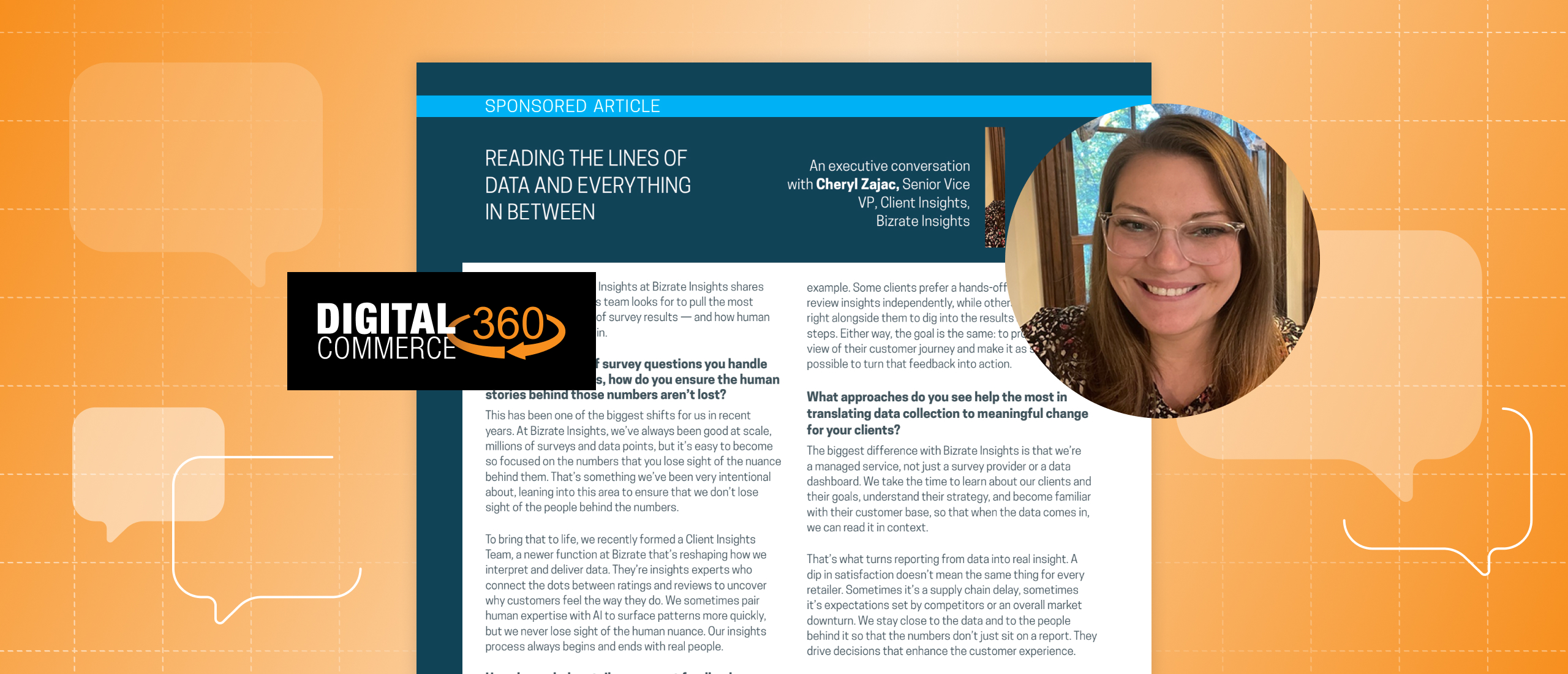
Cheryl Zajac, VP, Client Insights at Bizrate Insights shares the types of context its team looks for to pull...

For the eighth year, Bizrate Insights has been recognized as a leading vendor to North America’s top 1,000 ecommerce...
Updated 11/25: The following blog is adapted from Bizrate Insights’ past library of white papers and guides that we’ve...


