/ resources
October 2, 2025


Content Manager, Bizrate Insights
Updated 9/25: The following blog is adapted from Bizrate Insights’ past library of white papers and guides that we’ve made publicly available. Enjoy!
For a PDF download version of this report: Download Now
OverviewFor small- and medium-sized businesses (SMBs) and startups, having a Your marketing strategy should serve as a long-term plan that defines the direction of your business and outlines the tactics you’ll take to position your brand to consumers. Whether your current plan needs a tuneup or you’re starting from scratch, |
In this guide, we’ll break down:1. The four essential elements of any ecommerce marketing strategy. 2. Tips for leveraging negative reviews. 3. Best practices for responding to negative customer feedback. 4. When to delete a negative review. |
Before executing your ecommerce marketing strategy, you need to carefully choose your target goals.Here’s a brief list of common goals many SMBs and startups aim to achieve:

You don’t have to limit yourself to just one goal. However, it’s important you remain focused and don’t overextend yourself or your team. Once you’ve clearly defined your goals, you’ll be able to sketch out a concise strategy and start working toward achieving your objectives.
Your ecommerce strategy will become the foundation for future marketing and advertising efforts. To ensure success, be sure to include the following elements in your plan.
By creating detailed customer personas or profiles, you can identify your target audience’s needs, wants, pain points, and interests, which will influence how your brand communicates and markets itself to key consumers.
Startups and SMBs should take a granular approach to develop consumer profiles. In doing so, you can identify who your real decision-makers are, what they’re trying to achieve, the problems they face, and their budgets. From there, it will be easier to develop customer-centric messaging that keeps consumer goals at the forefront of marketing efforts.
Studies show that 78% of marketers believe factoring brand purpose into marketing messaging is more critical than ever in today’s society. So use your consumer personas to define your brand’s tone, develop core messaging, and determine which marketing tactics will most effectively reach shoppers.

Competitor analysis enables your small business or startup to identify the strengths and weaknesses of key players in your industry. The end goal is to identify gaps in the market and determine opportunities for you to differentiate yourself in the eyes of consumers. As you refine your strategy and collect more data, you can also benchmark your performance against competitors and identify areas for improvement.
If you have already collected data on your current performance, then consider adding benchmarking as part of your competitor analysis. This process will help you gauge the effectiveness of your ecommerce marketing strategy in relation to other businesses and ultimately give you an edge.
To set benchmarks, you should first define key performance indicators (KPIs). These KPIs will depend on your strategy’s core objectives. So, if you’re aiming for growth, then measuring website traffic, social media followers, and customer retention rates may be fitting indicators to start out.
Once the KPIs are defined, you’ll want to ensure you are continuously collecting data to fuel your measurements. You may need to leverage third-party tools like Google Analytics, voice-of-customer (VoC) feedback solutions, or keyword research platforms. Once you have the tools in place, you can compare your data to your benchmarks to assess your marketing performance.
A powerful ecommerce strategy is not complete without a good tech stack. SMBs or startups can leverage technology to streamline processes, ensure an optimal user experience (UX), and keep consumers coming back for more.
Consider that more than 56% of shoppers were accessing ecommerce websites from their phones as of 2021. With this in mind, you must make sure your online store caters to customers’ devices. Ignoring this critical information can cause frustration among target consumers, making them less inclined to visit your website or refer your store to others.
Best Practices for Building a Successful Ecommerce Marketing StrategyWhen it comes to assembling a successful marketing strategy, long-term profitability needs to be top of mind. Rather than focusing your efforts on increasing sales, create a strategic plan that yields long-standing results, accelerates business growth, and bolsters brand reputation. Best practices for SMBs and startups to achieve longterm ecommerce growth include the following. Factor Loyalty into Your StrategyWhen you keep the customer at the center of your ecommerce strategy, you’re more likely to turn a firsttime shopper into a brand advocate — a critical element for long-term business success, especially for SMBs and startups with tight budgets. Return buyers spend 67% more on average compared to new shoppers, making acquiring new customers five to 10 times more expensive. With this in mind, how can you continue to enhance customer experiences with your online brand to drive customer retention? The answer is to collect customer feedback and leverage the results. |
5 Things You Can Do with Customer Feedback1. Make targeted, data-driven improvements. 2. Better understand the quality of your customer experience. 3. Develop customerdriven marketing strategies. 4. Create connections throughout all customer touchpoints. 5. Use customer feedback as social proof to decrease cart abandonment. |

Continue to evaluate your marketing processes to identify new functions to automate — such as email marketing, lead scoring, and survey gathering — and improve efficiency. When you leverage automation, you can quickly process real-time data and then use those metrics to gain insights into shopper behavior and marketing performance.
Your email marketing is a prime area where automation can enhance campaign efficacy. For instance, you can leverage automation tools to
deploy promotions and new product announcements to inboxes at the right time. Streamlining these processes can also lead to better performance — such as higher open and click-through rates — and send more customers to product pages on your website.
As an SMB or startup, you can incorporate personalization tactics into your online store to create memorable shopping experiences. Personalization enables you to improve customer engagement, increase sales, and create a network of loyal, repeat shoppers who advocate your brand to others.
By growing shopper engagement and enhancing UX, personalization can lead to a 20% increase in customer satisfaction rates and a 10% to 15% rise in sales conversions. Examples of ways your small or startup business can personalize the shopping experience include:
Consumers are four times more likely to purchase from a company that demonstrates strong brand values.You need to define and share your brand’s mission in your marketing messages.
Brands that clearly — and authentically — convey their mission and values to customers grow three times faster on average than their competitors.In addition to accelerated growth, these brands also achieve greater customer satisfaction.
Your ecommerce store should have brand values that align with your target audience’s interests. For example, many brands include sustainability as a core brand value, and for a good reason.Sixty-eight percent of consumers are likely to factor a brand’s environmental, social, or political stances into their purchase decisions, according to a Bizrate Insights survey of 550 consumers. No surprise, more companies are adopting sustainable practices and integrating environmentally conscious messaging into their marketing strategies.
Leveraging search engine optimization (SEO) tactics can increase organic search traffic and help your website rank higher on search engine results pages (SERPs) for keywords related to your products. Essentially, successful SEO increases qualified organic traffic to your site.
SEO is a critical element of a long-term ecommerce strategy as more and more shoppers rely on online platforms to find new products. Year-over-year trends from 2019 and 2020 showed a 27% increase in ecommerce website traffic.These numbers project to rise as more digitally savvy generations — such as Millennials and Generation Z — take over the consumer market.
With the pandemic increasing consumer preference for online shopping, it’s more important than ever to prioritize SEO to increase visibility for your site and stand out from competitors in organic search.

Creating a robust and powerful ecommerce marketing strategy for your business is a two-pronged approach: First, you need to construct the plan, then you should continue to refine it to achieve maximum results.
You will want to leverage data analytics to measure marketing outcomes, evaluate what works, identify top customer segments, optimize sales, and make changes to enhance processes.Incorporating data collection into your ecommerce strategy ensures you have the metrics you need to formulate insights and drive your plan to success. By continuously assessing data, you can better understand what drives shopper engagement, improve UX, and maintain your competitive advantage by constantly evaluating data.

For example, ecommerce stores can use customer feedback to identify pain points in their shipping processes, website, or product availability to drive changes that make the shopping experience more convenient. With buying trends showing that 43% of consumers will pay more for convenience, enhancing the online buying experience can increase ROI and drive customer loyalty.
Data collection can help you refine your marketing budget and invest in channels that yield profitable results. SMBs and startups have limited funds, so they must identify which channels deliver the best results and continue to invest in them. There are also digital solutions — like Bizrate Insights’ Online Buyer Survey — that ensure ecommerce companies receive consistent and reliable data to help drive their marketing strategies.

Developing a winning ecommerce marketing strategy can feel overwhelming when you’re trying to grow your small business or startup. But with the right tools at the right price, your growing business can create a plan that aligns with your target objectives and maximizes ROI.
Bizrate Insights’ business intelligence tools empower growth and support SMBs and startups looking for an easy-to-use solution to help make informed decisions. Talk to us today about our free survey solutions and find out how you can use them to build better customer relationships, enhance brand awareness, and achieve long-term growth.
For a PDF download version of this report: Download Now

Qualtrics is one of the best customer experience and market research platforms on the market, but not every ecommerce...
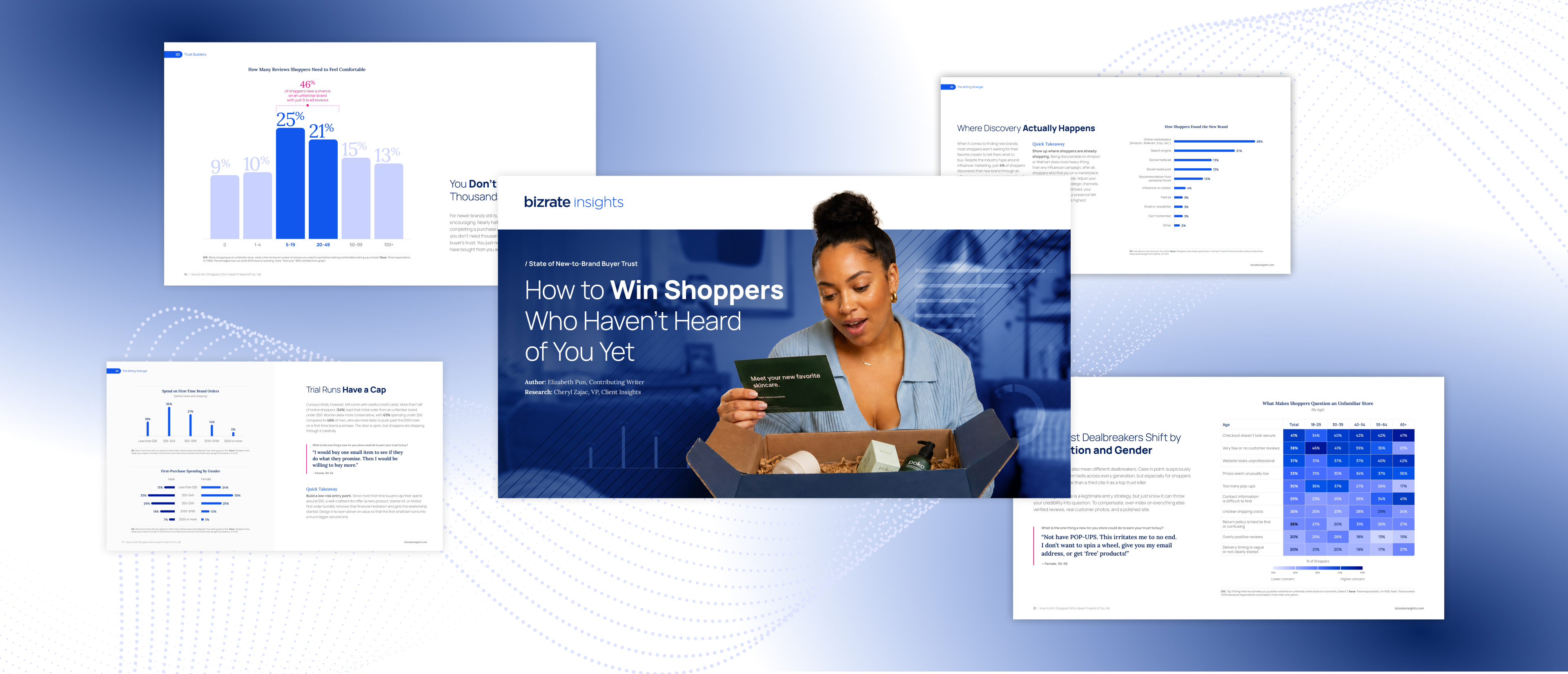
First-time buyers are out there, and they’re willing to spend with you if you can put them at ease. Our latest research shows what helps shoppers feel ready to take a chance on a new brand.

New back-to-school shopping data shows shoppers are blending online and in-store channels, spending more, and looking for convenience, value, and confidence.


