/ resources
September 23, 2025


Content Manager, Bizrate Insights
Updated 9/25: The following blog is adapted from Bizrate Insights’ past library of white papers and guides that we’ve made publicly available. Enjoy!
For a PDF download version of this report: Download Now

For marketers, sales leaders, and ecommerce managers, measuring and optimizing performance requires constant attention. By analyzing your own metrics, you can identify areas of strength and uncover vulnerabilities that need improvement. Benchmarking your performance against industry leaders provides a more objective perspective, allowing you to make meaningful comparisons with retailers that directly impact your bottom line.
Benchmarking helps you focus on the right growth levers that drive key ecommerce goals—whether that’s acquiring new customers, boosting retention, or increasing revenue. However, comparing yourself against irrelevant competitors or missing critical metrics can obscure your true performance and limit your ability to make informed decisions.
In this guide, we’ll walk you through the essentials of benchmarking, including how to get started, the tools you should leverage, and how to apply your findings. By using this approach, you’ll be able to create SMART (Specific, Measurable, Achievable, Realistic, and Timely) goals that set you up for sustainable, long-term growth.
What is Benchmarking?
Benchmarking is the process of measuring a company’s performance, processes, or products against competitors—usually the top-performers of a given industry. The goal of benchmarking is to compare your business to an objective standard to have a more relevant measure of success you can use to identify growth opportunities.
6 Steps to Efficient Benchmarking
To accurately assess your performance, your team should regularly carry out competitive analysis,and benchmarking is a great way to analyze everything from product offerings to customer service.
With so many potential competitors and metrics to monitor, a streamlined process will help keep your team on task. Use the following six steps to optimize your benchmarking process.
1. Choose a facet (or facets) of your business to benchmark.
This could be as specific as product features or as broad as an entire department, like customer service. Consult with all key stakeholders when gathering insights to be sure your teams are aligned.Focus your comparison on the areas that have either been historically problematic or show the most potential for growth.
Remember that you are looking for both glaring holes in your strategy and emerging trends (e.g. specific promotion channels) that your competitors leverage. For example, if a direct competitor has a huge following on TikTok and you don’t even have an account, then bookmark the idea for later research.
2. Identify the most relevant competitors.
Start by researching your own vertical as well as companies in adjacent markets. For instance, if you
sell sunglasses, benchmark against other accessory brands who target the same demographics and
offer products a shopper might buy instead of sunglasses.
When choosing your competitors keep in mind the following considerations:
Size: Compare yourself to companies within your range of price, employee numbers,and if applicable, brick-and-mortar locations, so that it’s a relative comparison. If you find yourself going after companies on a larger scale simply because they are the gold standard, ask yourself if they would consider your business a competitor. This helps keep your comparison feasible since you won’t be able to meet the same price or production rate as a company three times your size. If you can’t emulate the best practices that lead to their success, then there is no reason to compare to them. Instead, look for weaknesses in their metrics that you can exploit, and where being smaller gives you an advantage.
Relationship: Are they a direct competitor, closely related, or a leader in your industry? For a useful comparison, focus on brands directly or closely related to yours. You can include the top-tier brands to gain inspiration, just remember to be realistic when it comes to setting goals.
3. Gather your internal data.
Pull quantitative data for the performance metrics you want to compare. We suggest looking at website traffic and engagement, SEO, social media, sales and fulfillment data, and customer satisfaction to start. Then, work on transforming qualitative data such as share of voice (SOV) and brand awareness into tangible metrics that can be compared. You can leverage Google Analytics, AdWords, and social media analytics to calculate your own SOV, and we’ll cover how to dig in to your competitor’s SOV in the next section.
4. Gather competitor’s data.
Start by compiling easily accessible public data such as pricing, product mix, and promotion channels. Look into published content like news coverage, press releases, conference presentations,or marketing materials that discuss their features or product roadmap.
Leverage third-party tools to explore the less accessible, but important metric of share of voice and share of market. While you may not have direct access to competitors’ data, many tools offer competitor insights that allow you to easily view your metrics compared to the domain/URL of your choice. If you can’t find what you’re looking for, you can still manually calculate where they are succeeding over your efforts and reverse engineer insights to figure out who owns the largest share of market and voice.
Use SEO research tools for organic traffic, keyword rankings, website, and domain data, sites like Buzzsumo for topic authority, Google AdWords for PPC and impression share data, and social media analytics platforms to gauge performance.

5. Compare your data to your competitors.
Identify where you overlap, the gaps in your business, and where you perform below your competitors. Determine the specific features, processes, or practices that help them succeed and use those learnings in the next stage.
6. Use your findings to create SMART goals.
Use your results to create if/then statements to outline proposed next steps. This could be something like, “If we increase our social media promotion efforts, then we will expand our share of voice for our target search terms.”
Once your team agrees on the most important efforts, then turn those into SMART goals. (Reminder,SMART stands for Specific, Measurable, Achievable, Realistic, and Timely).
Using the above example, this could be: “If we increase our organic and paid social media promotion efforts by 30% in the next quarter, then we will expand our share of voice and increase visibility for our target search terms. We will increase Twitter impressions by 15% and our branded hashtag [enter hashtag] will have 300 results on Instagram by the end of Q3.”
Go Beyond Surface-Level Metrics
In addition to understanding a competitor’s product, pricing, plans, CX, and branding, you should also look into their relationship with their customers. You can glean a certain amount from digging into their marketing techniques, website UX, and loyalty programs, but investigating their voice of customer data—which includes quantitative data like overall satisfaction scores and NPS, as well as seller ratings, reviews, and feedback—will allow your company to pinpoint the exact areas where you need to improve to reach the top of your industry.
Most VoC software companies focus their benchmarking on general satisfaction indexes like net promoter scores (NPS) because they can’t offer anything beyond that. But there are myriad reasons a shopper would recommend a brand to someone, and to uncover real insights you can turn into action, you need to go beyond NPS.
That’s why Bizrate offers a robust benchmarking tool where our partners can customize their benchmarking process based on their goals. Partners can choose who to benchmark against (based on predetermined categories such as best in class, industry, or a custom category), and which metrics to compare. You can measure against core KPIs like NPS, but you can also dive deeper into satisfaction indicators across four additional areas.
Below we’ll go over the most valuable ways to efficiently use our benchmarking software to analyze your performance against the competition.

|
Inside Bizrate’s Benchmarking Tool Benchmark by key performance indicator (KPI) metrics: Our partners can benchmark for all of their KPIs in the VitalSigns dashboard, which includes overall satisfaction (OSAT), likelihood to buy again, and likelihood to recommend. Benchmark by all additional data points: Bizrate’s unmatched benchmarking tool allows retailers to go beyond quantitative data and NPS scores. Our additional metrics include a robust list of detailed points across usability, marketing, fulfillment, and customer support categories. Benchmark against competitors using several categories: You can benchmark by our Circle of Excellence winners, who are the best in class and top-rated retailers in our network, by industry category, or with a custom category created by your client development manager. One example of a custom category is to benchmark against wallet share. For example, if you are a high-end jewelry retailer and have already measured against your direct and closely-related competitors, you can also measure against related retailers in your price point for other luxury products. This helps you gauge the customer experience of other companies that your customers likely shop with as well. In the screenshot, you can see a real retailer’s data table listing the monthly average scores for Design of Site at point of sale (POS), the total number of scores submitted by customers, and their rankings against the Circle of Excellence winners. |
 |

Benchmark against your industry category: The below image shows the same retailer comparing their results for Design of Site at POS compared to their industry average. Notice that there is both a total and the monthly average. Our data is updated in real-time so you are always getting current results to measure against.

Benchmark and filter results based on customer engagement point: Because of our two-part survey, Bizrate Insights partners can filter results based on the point at which a customer is providing feedback—either at point of sale or post-fulfillment. This two-part survey allows retailers to immediately see exactly where a customer’s satisfaction may have dropped off, whether point of sale or post-fulfillment.
You can see the first of the two tables below includes a daily breakdown of customer-submitted scores for ranking the product selection at point of sale, benchmarked against their industry category, health and beauty. The second table includes results to the post-fulfillment product satisfaction question.


The ability to benchmark at several critical points in the customer experience and learn how shoppers feel about a variety of metrics allows your team to pinpoint specific stages where your team can improve.
Additionally, Bizrate Insights’ partners can leverage The Panel, our consumer market research tool that allows retailers to gather market intelligence from specific demographic profiles. These surveys are purchased on top of a Bizrate Insights subscription and can help you ask respondents in your target demographics how they feel about specific competitors, experiences, or products.
Continually Monitor Your KPIs and Optimize
The benchmarking process is detailed and will take dedication from your team, but when done accurately, you can uncover valuable insights that will help your company improve every success metric that impacts your bottom line.
Schedule a call with us to learn more about how Bizrate Insights can offer you valuable voice of customer data and unmatched benchmarking capabilities in one seamless product. With robust VoC data and competitor analysis you can continually optimize your ecommerce strategy to grow your customer base, reduce site abandonment, and create lifelong customers.
For a PDF download version of this report: Download Now
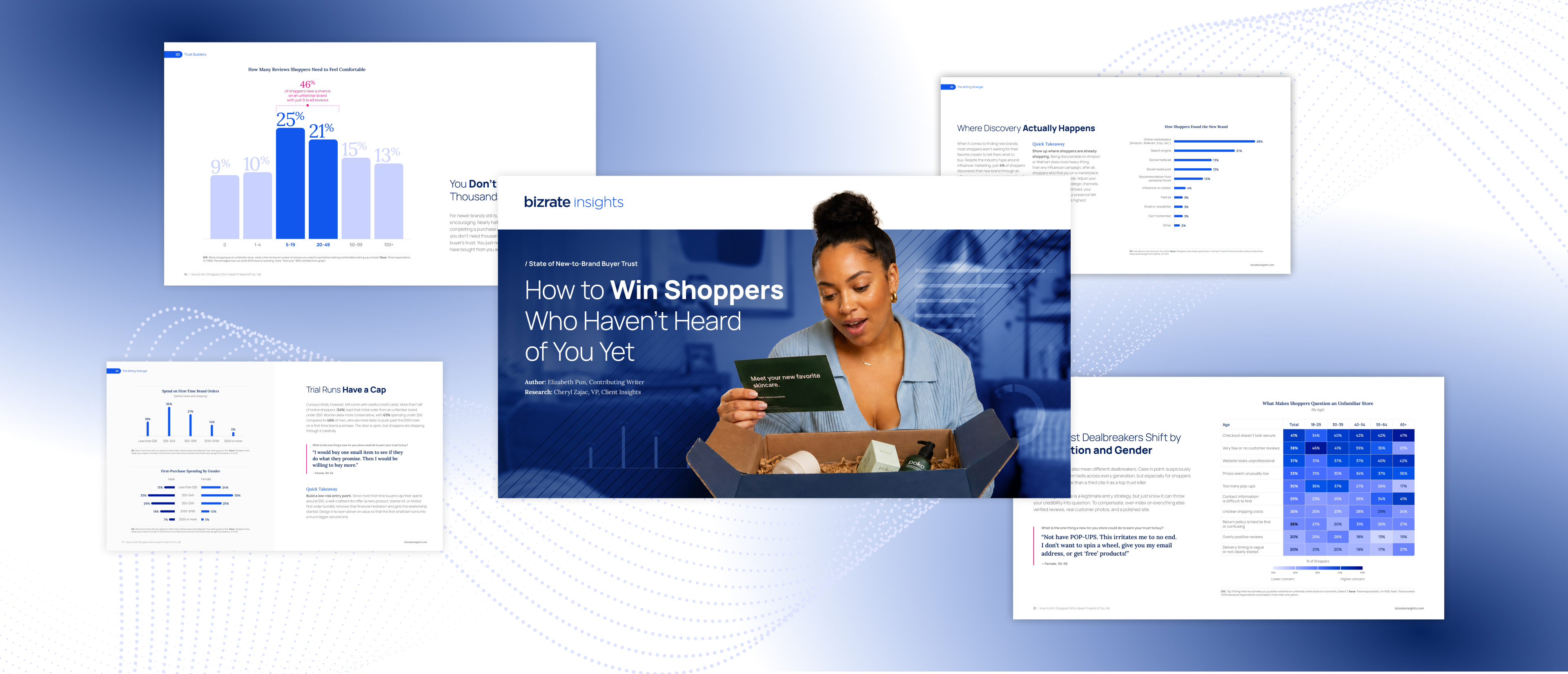
First-time buyers are out there, and they’re willing to spend with you if you can put them at ease. Our latest research shows what helps shoppers feel ready to take a chance on a new brand.

New back-to-school shopping data shows shoppers are blending online and in-store channels, spending more, and looking for convenience, value, and confidence.

Introduction A customer orders from your brand, has a terrible delivery experience through DoorDash or Instacart, and leaves a...


