/ resources
September 23, 2025

Content Manager, Bizrate Insights
Updated 9/25: The following blog is adapted from Bizrate Insights’ past library of white papers and guides that we’ve made publicly available. Enjoy!
In the digital age, online reviews shape our purchasing decisions. Google Reviews have gained popularity for their impact on the reputation of a business and its customer acquisition.
Whether a small business owner or marketing professional, this whitepaper offers valuable information and actionable insights to leverage Google Reviews for growth.

Do you ever look at reviews prior to making a purchase? According to Statista, over 91% of online consumers look at reviews prior to buying. What’s more, people look at the number and source of reviews. The more reviews, the higher the trust factor. An ongoing study by the Wharton School of Business confirms that adding reviews to a shopping platform invariably has a positive effect—by increasing customer trust while incentivizing providers to deliver good service.
We’ve known since the dawn of marketing that word-of-mouth is the strongest form of advertising. As both advertising and direct marketing have become more pervasive, customers have developed a mistrust and apprehension about ads, promotions, and sales gimmicks. In this zeitgeist, reviews from other customers reign supreme. Customers perceive a review as another shopper’s advocate, as an evangelizer, and as a cushion that can save them from a bad experience. When it comes to shopper confidence, reviews are trusted much more than any sales copy.
As the internet developed, review sites have grown with it. There are sites devoted to medical reviews—such as HealthGrades. Lyft and Uber have both developed inbuilt bilateral ratings and review systems. Yelp built their entire business model around reviews, aimed primarily at hospitality and services.
For purchased goods, the giant in the room has always been Amazon, and Amazon owes much of its success to its starred customer ratings and reviews.
Facebook also has a ratings system for its store pages. However, Meta has been faltering in their ecommerce market share because people visit Facebook to be social—they don’t arrive with purchase intent.
Without a doubt, the most vital rating system on the internet currently is Google Reviews.
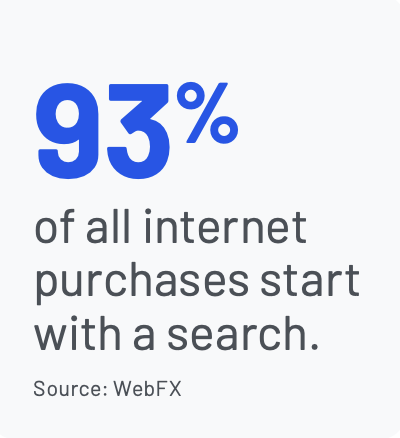
According to WebFX, 93% of all internet purchases start with a search. Google dominates search and remains the primary gateway for people seeking information online.
Even when your potential customers have seen your advertising on TikTok, Instagram, or any other platform, they’re highly likely to perform a search to see what people are saying about your store and your products.
1. Improve SEO
Google has long dominated the search game. While reviews on other sites might help improve SEO, there’s nothing like the home court advantage. Working hand-in-hand with Google itself is the most reliable way to get a search-optimization boost, especially if you make it into the Google Local Pack—that cluster of three local businesses listed at the top of a search page.
|
2. Improve Click-Through Rate Google Reviews are highly trusted. When users see your Google Reviews, they’re a lot more likely to visit your site. Not only that, but an average star rating will be added to your Google business listing, and if that star rating is above 4 stars, this incentivizes users to come to your store. 3. Indicate Store Activity Aside from buyer perception of high or low quality, people want to see that your store is open for business, and that users are making purchases on your site. People don’t like “the path least traveled”—they want to take a well-traveled path. Google Reviews say more than just the star ratings themselves—they say consumers are making purchases at your store, which encourages the user to do so as well. |
 |
4. Convey Transparency
A lack of reviews in 2023 makes users wary. The two immediate assumptions are: either your site is not very robust, which conveys impermanence and unreliability, or the site owner deliberately chose not to show reviews—which sends a message of dodginess and lack of accountability. Speaking plainly: in 2023, not having reviews on your site says “flight-by-night operation” and scares customers away.
5. Increase Interaction with Customers
User feedback and reviews create opportunities for interaction. By responding to reviews, you send a strong message that you care enough to address customer-service issues.
|
Collecting Google ReviewsUnderstanding the customer’s experienceWhile leaving a Google Review is a fairly quick process, the user journey is somewhat counter-intuitive and not totally straightforward. This is what a user has to do to leave a review: 1. Search for your business As you can see, this can feel onerous to someone who’s not heavily intent on writing a review. |
Tip #1: Create a shortcut for Google Reviews
To do this, go to your Google My Business account, click the Home tab, and find the “Get your first review” (or “Get more reviews”) card. Click “Share review form” and copy the link to your clipboard.
Tip #2: Shorten your review shortcut
It’s easy enough to drop this link into a button on your website or hyperlink it through shorter anchor text. But the really long link to Google Reviews won’t work for sharing on print media. Using a link shortener like bitly.com, you can shorten and even customize your review link.
Tip #3: Link out to your Google Reviews page from your website
If a customer wants to leave a review for your business, the first place they’re probably going to look is your website. Place your link on your site—on the Contact Us page.
Tip #4: Create a dedicated page on your website for Google Reviews
An even better approach is to dedicate a full website page to Google Reviews (or reviews in general), accessible from your main navigation menu. The page should contain both a CTA to write a review and include existing reviews. These not only encourage prospects to become a customer but also give that added inspiration for an existing customer to leave a review.
You can populate your reviews page via screenshots, but ideally, you want them in text form. The reason is that reviews are often keyword-rich, so including them on your website in a way that Google’s crawlers can “read” makes for a great small business SEO strategy. There are also platforms and plug-ins that allow you to aggregate your Google Reviews onto your website automatically.
Tip #5: Include a Google Review CTA in your footer
In addition to or instead of having a designated page for Google Reviews (or reviews in general) on your website, you may also want to include it in your website footer. This way, your customers can find it as easily as your Contact Us page.
It’s common knowledge that people are more predisposed to leave negative feedback than positive words. This is a natural human bias: we only give praise at very specific moments. In turn, the window for criticism is much wider. People live busy lives. It’s rare for a customer to be persuaded to go out of their way to sing your praises unless it’s directly in their purchase path.
And this is where the danger lies. When a store owner requests reviews through social media, email marketing, surveys, or business mailouts, the customers most likely to comment, rate, and review are those with grievances to air. Luckily, there’s a solution to this.
We spoke earlier of the narrow window when a customer is most predisposed to review favorably. There are actually two such moments: The first is immediately after they’ve successfully placed their order, and the second is when they receive their goods.
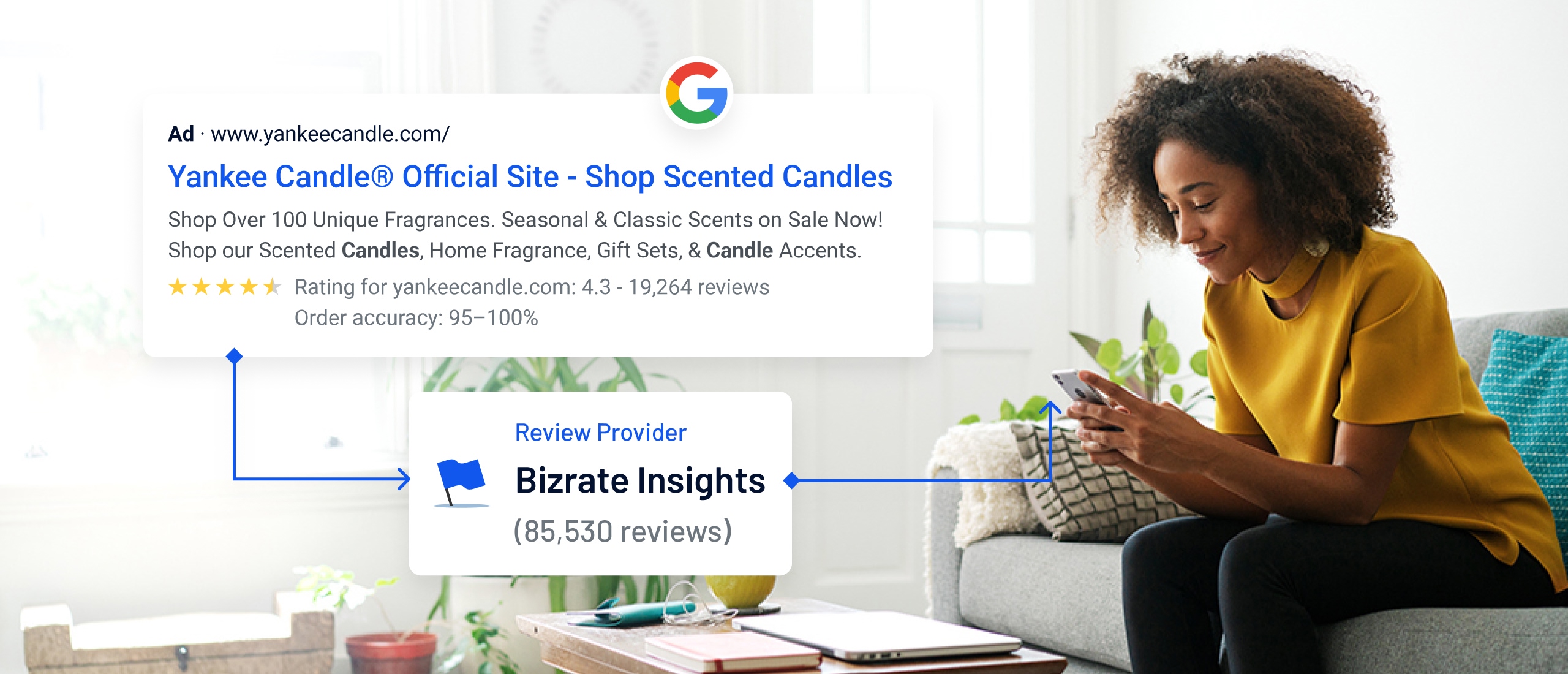
Bizrate Insights’ solutions collect shopper feedback about their experience and gathers several key metrics and verbatims within the survey, which are then directly syndicated to Google. This in turn improves your online store’s Google Ratings with zero additional work on the retailer’s end.
Contact us today to quickly boost your Google Seller Ratings and, in turn, your online reputation.

Discover the latest online shopping habits and consumer triggers from mobile-first preferences to shipping incentives that successfully move shoppers from browsing to buying.

Retail media ad spend is hitting $24B in 2025. Explore new consumer data on how trust, first-party data, and retail media networks are driving 61% of shoppers to buy.

TikTok has become more than a trend engine. It’s also now a functioning retail channel.


